
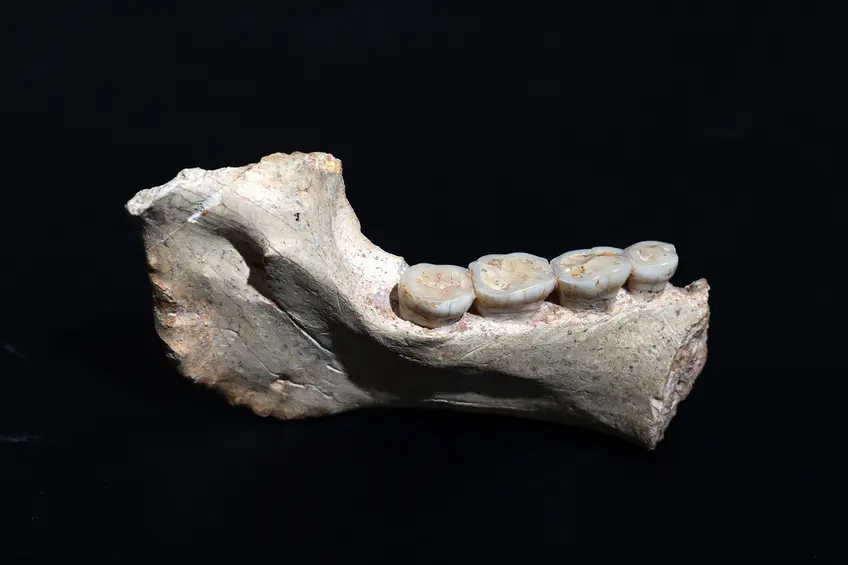
In early January 2026, an international research team published a groundbreaking study on primitive human fossils from Thomas Quarry I in Casablanca, Morocco. These fossils — including jaws and teeth dating back roughly 773,000 years — offer new clues about human evolution, especially the dental morphology that helps scientists trace deep ancestry and population diversity.
A New Window into Hominin Diversity
The discovery from the Grotte à Hominidés site represents some of the oldest well-dated hominin remains in Northwest Africa. Among these are several dentally preserved specimens — a nearly complete adult mandible, a juvenile jaw, and isolated teeth — that have become key to understanding early members of our genus Homo.
What makes these teeth especially significant is not just their age but their internal structure. By using high-resolution micro-CT scanning, researchers examined the enamel-dentine junction (EDJ) — a hidden layer of the tooth beneath the enamel that retains vital morphological information even when wear has eroded the external surface. This structure preserves taxonomically informative features that help distinguish different hominin groups.
Primitive and Derived Features in Dental Morphology
Analysis of the EDJ and other non-metric dental traits (features not easily quantifiable by measurement alone) revealed a striking mosaic:
- The hominin teeth show many primitive characteristics not typical of later human species.
- They lack key Neanderthal dental traits, distinguishing them from later Eurasian populations.
- Compared to Homo antecessor — a roughly contemporary hominin species known from Spain — the Moroccan teeth retain a more generalized morphology.
These findings suggest that regional variation in dental traits was already present by the late Early Pleistocene, implying that ancient populations within Africa had become differentiated long before the emergence of fully modern humans.
Dental Clues to Our Common Ancestors
Teeth are among the most informative fossilized remains because they preserve evolutionary history at both external and microscopic levels. Their shape, cusp patterns, enamel thickness, and the EDJ all record genetic and adaptive signals. In the Moroccan hominins:
- The combination of dental primitives with features approaching later human forms points to a population ancestral to both Homo sapiens and certain archaic Eurasian lines.
- This positions these fossils close to the last common ancestor of modern humans, Neanderthals, and Denisovans — a long-sought figure in human evolutionary studies.
Why Dental Features Matter in Paleoanthropology
In hominin research, teeth are not simple chew-tools — they are evolutionary archives. Unlike fragile bones that can deteriorate over time, teeth endure and record growth patterns, developmental sequences, and functional adaptations driven by diet, environment, and genetics.
Even subtle dental traits — such as the grooves and ridges at the enamel-dentine junction — can:
- Distinguish species,
- Track migration and population splits,
- Reflect life history traits like childhood growth rates,
- And provide clues about diet and environment.
This makes dental morphology a cornerstone of reconstructing our species’ deep history.
A Pivotal African Chapter in Human Origins
The Moroccan hominin dental record strengthens the view that Northwest Africa was not a backwater in early human evolution. Instead, it played a central role in shaping the diversity of Homo populations — a role that dental science now helps illuminate with unprecedented detail.
As scientists continue to refine dating methods and scan fossil teeth with ever-more powerful imaging tools, these silent remnants from the past will continue to tell us not only who our ancestors were, but how they lived, developed, and diversified — one tooth at a time.