Royal Philips has announced the expanded commercial availability of LumiGuide 3D Device Guidance, the world’s first real-time, AI-enabled therapy solution that enables light-based 3D navigation for image-guided procedures. From January 2026, the technology will be broadly available across key European markets and the United States, marking a major milestone in radiation-free navigation for complex endovascular interventions.
Originally unveiled at RSNA 2025, LumiGuide represents a paradigm shift in AI-enabled therapy, allowing clinicians to visualize and guide devices inside the body using light instead of continuous X-ray imaging. This innovation supports Philips’ long-term commitment to improving radiation safety while enhancing procedural precision and efficiency.
Transforming Image-Guided Therapy with AI and Light-Based Navigation
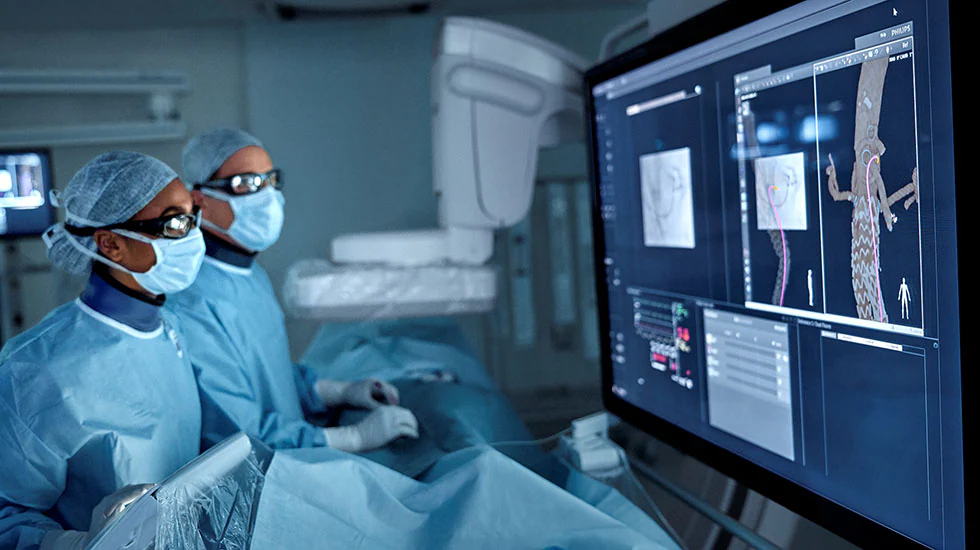
At the core of LumiGuide is Philips’ Fiber Optic RealShape (FORS) technology, which uses reflected light within an optical fiber embedded in guidewires and compatible catheters. This enables real-time, full-color, three-dimensional visualization of device shape and position—without the need for X-ray imaging.
Artificial intelligence plays a critical role by rapidly and accurately aligning device images with patient anatomy, supporting confident navigation even in highly complex cases. As a result, LumiGuide elevates AI-enabled therapy by combining real-time insight, radiation-free visualization, and advanced anatomical alignment.
Clinical data show that complex aortic repair procedures can be performed up to 37% faster, with as much as 56% reduction in dose area product (DAP), significantly lowering radiation exposure for both patients and clinical teams.
Seamless Integration with the Azurion Platform
LumiGuide is fully integrated into Philips’ Azurion image-guided therapy platform, a proven system used to treat more than 6.4 million patients annually across over 80 countries. This seamless integration allows LumiGuide to become part of a growing ecosystem of intelligent tools designed to improve outcomes, workflow efficiency, and procedural safety.
By embedding LumiGuide into Azurion, Philips is redefining how AI-enabled therapy supports clinicians throughout the entire procedure—from planning and navigation to treatment execution—with greater precision and confidence.
Clinical Impact and Physician Experience
The benefits of LumiGuide are already evident in real-world clinical practice. According to Adam W. Beck, MD, Professor and Director of the Division of Vascular Surgery & Endovascular Therapy at the University of Alabama at Birmingham:
“I have done over 160 fenestrated and branched aortic procedures with LumiGuide and have found that the system improves efficiency, reduces the procedure time, and reduces time on the fluoroscopy pedal to near zero.”
Such feedback highlights how AI-enabled, light-based navigation can meaningfully reduce procedural burden while maintaining high clinical standards.
Expanding Access to AI-Enabled Therapy
Following a successful limited market release in late 2023, LumiGuide has already been used in more than 2,000 clinical procedures. The broader commercial rollout reflects Philips’ continued investment in clinical evidence generation and its goal of accelerating access to advanced AI-enabled therapy solutions in everyday practice.
By expanding availability, Philips aims to support more hospitals in treating complex vascular disease with enhanced safety, reduced radiation exposure, and improved procedural efficiency.
Advancing Radiation Safety in Image-Guided Therapy
LumiGuide strengthens Philips’ comprehensive portfolio focused on low- and no-dose interventions. Alongside innovations such as Azurion with ClarityIQ, DoseAware, EchoNavigator, and ongoing clinical programs like the RADIQAL trial, LumiGuide reinforces Philips’ leadership in safer, more sustainable image-guided therapy.
Through the integration of artificial intelligence, advanced imaging, and intelligent device guidance, Philips continues to shape the future of AI-enabled therapy—making minimally invasive procedures safer, faster, and more effective for both patients and healthcare professionals.